Gears & Mechanisms
Educational Gear Examples 5 - Intermittent
SKU 3DPW-pr-1504642
$59.00NZD
In stock · Made-to-order resin · Ships from Auckland · Free shipping over $75
- Material
- High-Detail Resin (8K)
- Colour
- Grey
- Weight
- ~40 g
- Print time
- ~4.5 h
- Shipping
- $10 std · $20 express
- Lead time
- 1-3 d print + 1-4 d ship
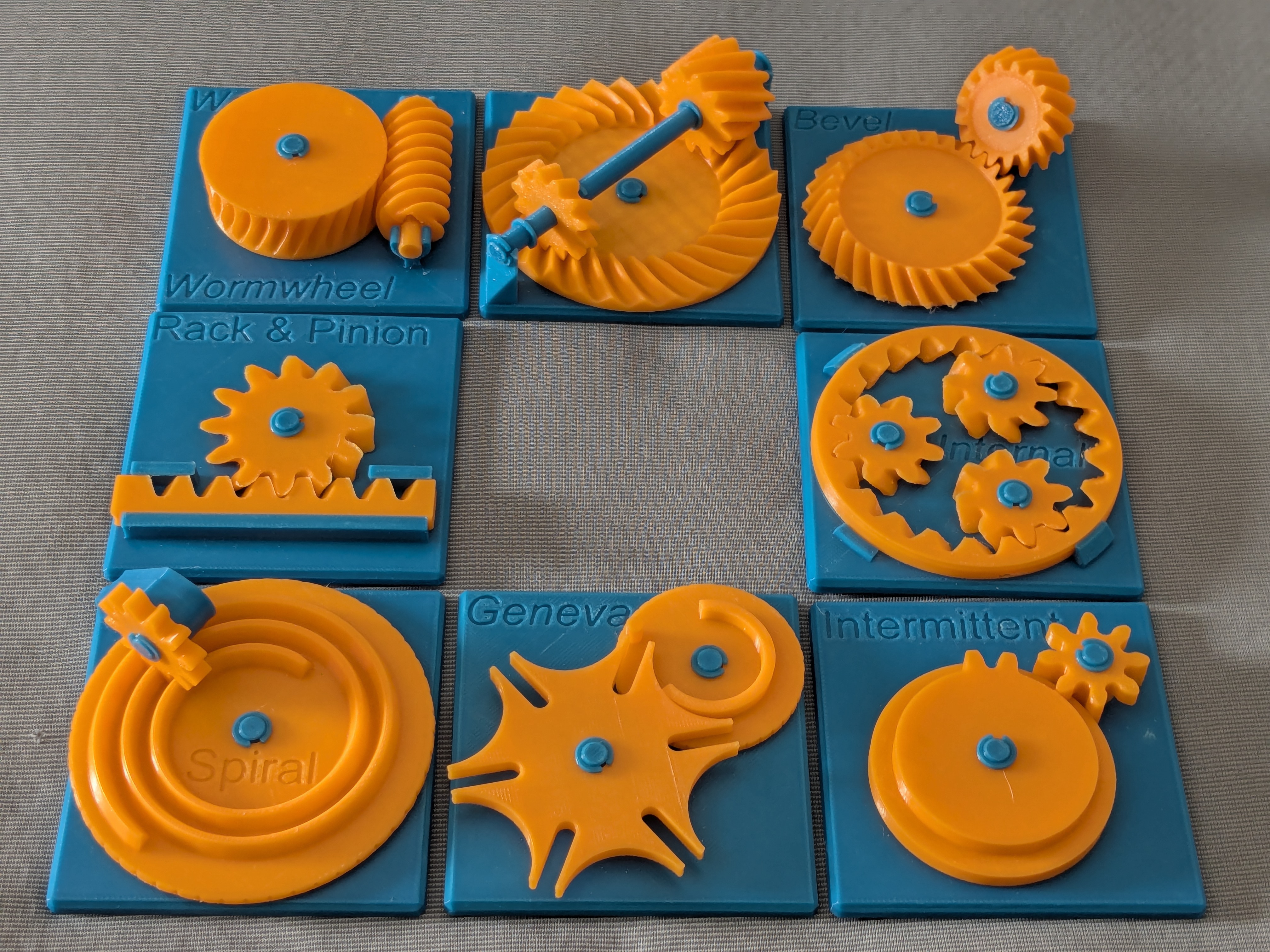
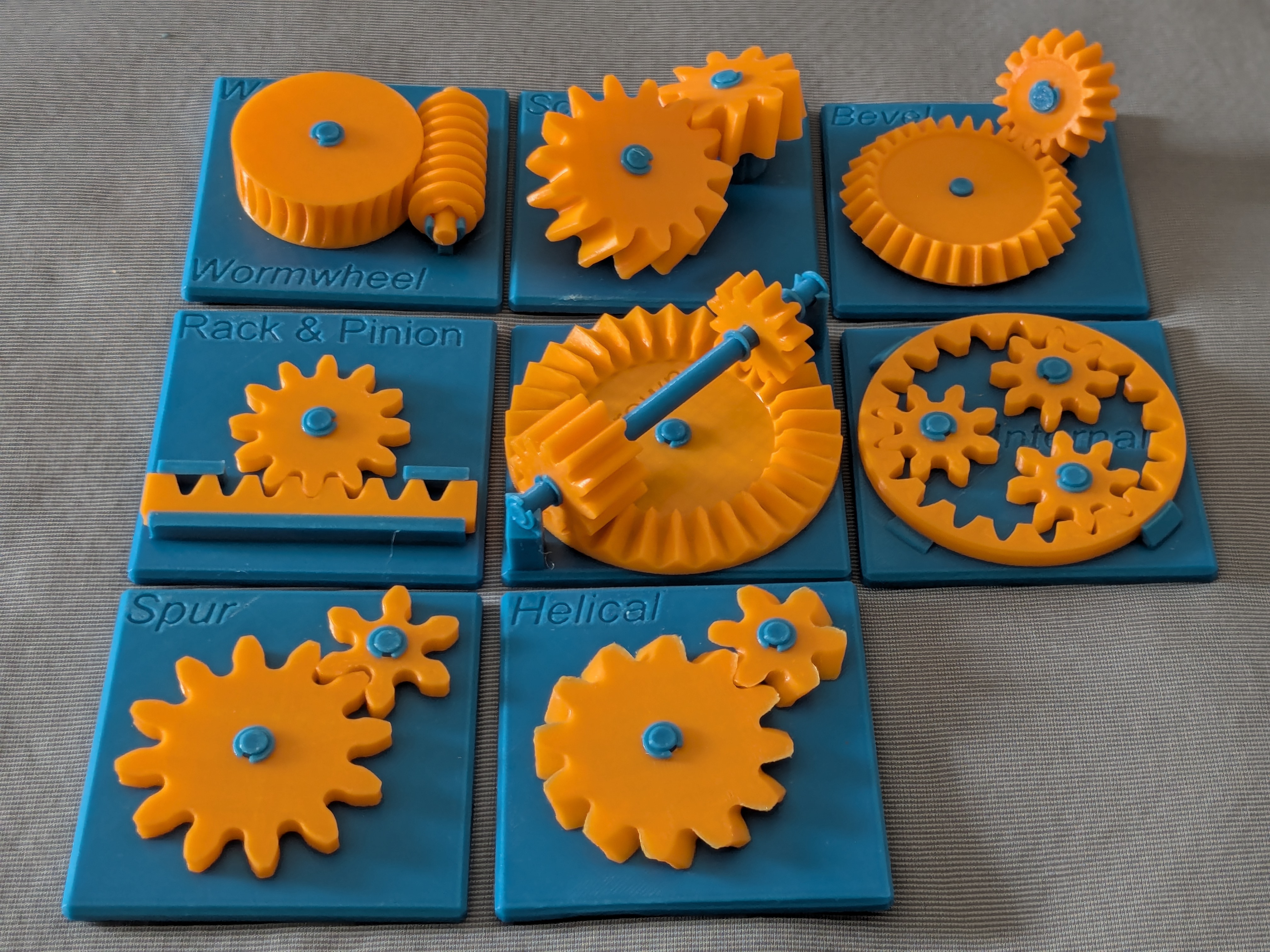
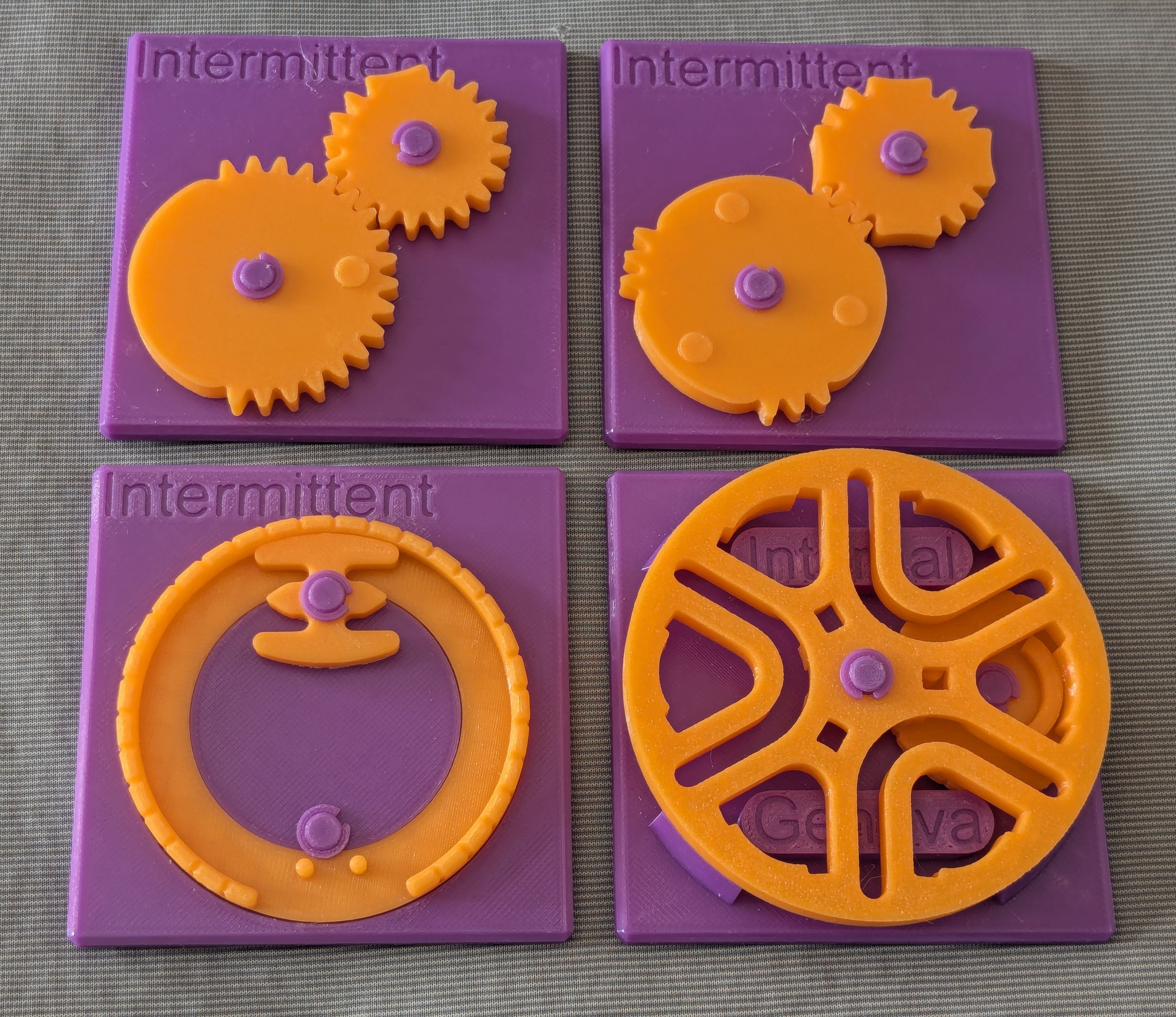
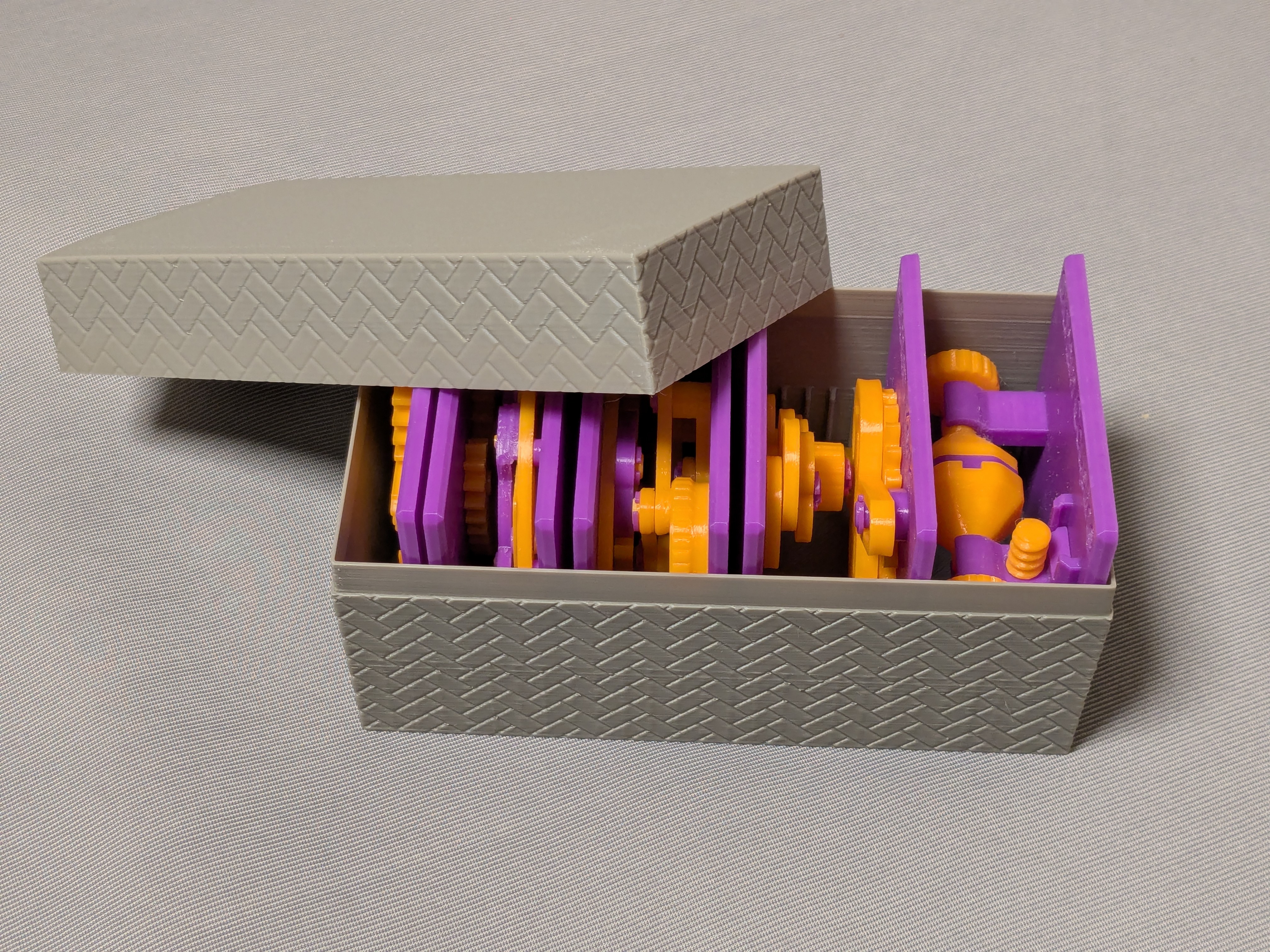
My Educational Mechanical Examples SeriesThis model is one of my educational mechanical mechanism examples on 80mm x 80mm base plates. You can find all models in the series in this collection => [Mechanical Mechanism Examples] This setThis present set contains: Intermittent Gear 1 Intermittent Gear 2 Intermittent Lantern Gear Internal Geneva Drive FOLLOW THIS LINK FOR THE INTRODUCTION VIDEO → https://youtu.be/9aCpXa-tHRA Brief DescriptionIn these intermittent gear systems, the larger gear serves as the input and the smaller one as the output. Each gear has teeth only along a portion of its circumference, so the gears engage and transmit rotation only when the toothed sections come into contact. When the toothless sections meet, the two gears simply touch along a circular arc centered on the input gear’s axis. In this phase, the gears slide against each other, allowing the input gear to rotate freely without driving the output gear. At the same time, this contact prevents the output gear from turning, holding it at a fixed angular position. To achieve multiple stops within one revolution, the toothed and toothless segments can be arranged in several places around the circumference of the output gear, as in the right system. Then, the output gear can be made to pause at multiple angular positions. We can tune the number and position of driving sections on the input gear. For example, if we reduce the number of driving sections from three to one in the right system, one full rotation of the larger gear results in a quarter turn of the smaller gear, which is pretty similar to the two-layer intermittent gear system included in my second set of educational gear examples. When the input gear has multiple driving sections, they do not have to be arranged symmetrically. Instead, we can tune the driving timing arbitrarily by tweaking the arrangement of the driving sections. In this system, the outer ring acts as the input, and the smaller uniquely shaped piece—resembling the Chinese character “王,” meaning “king”—serves as the output. The smaller piece can be regarded as a lantern gear with only two remaining teeth. The “teeth,” located on both sides between the two grooves, have profiles equivalent to cycloidal shapes shifted by the radius of the lantern pins, just like in a standard lantern gear. On the internal lantern-wheel side, only two pins are retained. Rotation is transmitted only when these two pins enter the grooves of the smaller piece. As the pins pass through, they drive the smaller piece through half a rotation. At all other times, the upper and lower ends of the smaller piece rest against the rim of the outer ring, blocking its rotation and holding it at a fixed angle. This gear system operates in a manner very similar to the two-layer intermittent gear system included in my second set of educational gear examples. In the present system, one full rotation of the larger wheel causes the smaller piece to rotate by half a turn, whereas in the other system, one full rotation of the larger gear causes the smaller gear rotate by a quarter turn. In both systems, the number of partial rotations of the smaller wheel—and their timing—can be freely adjusted by increasing the number of driving sections on the larger wheel. This is a model of an internal Geneva drive. The small wheel in the background is the input, and the larger wheel in the foreground is the output. The small wheel carries a short pin that moves inside the slot of the larger wheel. The central portion of the slot is an arc centered on the axis of the small wheel, while the remaining portions of the slot are straight. When the pin travels along one of the straight sections, it engages the walls of the slot and drives the larger wheel. When the pin passes through the arc section, it does not touch the slot, allowing the input wheel to rotate freely without driving the output. In addition to the pin, the small wheel has a circular boss that contacts the rim of the larger wheel during the free-rotation phase, holding the output wheel firmly in place. As in a conventional external Geneva mechanism, the output wheel in this internal version is accelerated smoothly from zero speed and decelerated back to zero, rather than starting and stopping abruptly like other intermittent mechanisms in this set. Related ModelOther two types of intermittent gears are contained in the other set: Geneva Drive (standard, external) Two-layer intermittent gear Fully teethed lantern gear with pin wheel is included in the other set: CaseThis model is compatible with the case included in my first set. PrintingUse the models named ???-printable.stl for printing. The models named ???-assembled.stl are provided just to show how they should be assembled. Use well-dried PETG to have better dimensional accuracy. Use 0.1 mm or 0.08 mm layer height to have smoother surfaces. Use slow printing speed for overhangs. Select “Random” seam position to have smoother rotation. Randomly distributed seam should be easily worn out after some wearing.Printing Sanding and FilingSometimes, the gears suffer from the stringing effect and/or elephant foot effect, resulting in a too tight fit to the shafts (they are designed with a 0.15 mm radial clearance). If you see rough surface on the shafts due to stringing, sand off the roughness with a small piece of sand paper. If you feel the gears do not rotate smoothly due to an elephant effect, widen the hole slightly by using a thin round bar file. Without those issues, the parts should rotate very smoothly with minimal friction. AssemblyJust secure the gears and wheels by the retaining rings. Updates2025-12-09 Remove interference on internal Geneva (v102) Made the labels "Internal" and "Geneva" smaller to remove their interference with the outer wheel. Thank @samol_101871 pointing out the issue. Other examplesYou may also be interested in the models in my educational mechanical mechanism examples. Find them in this collection: https://www.printables.com/@osamutake_3341417/collections/2728214 Happy printing! AcknowledgementI got into gears thanks to K.$uzuki's amazing articles and YouTube videos. Many of the mechanisms shown in this series came from the introductions on his website. He also makes excellent gear models himself. This series wouldn’t have existed without his inspiration. I learned a lot about technical detail of designing gear tooth profiles from Haguruma-No-Hanashi website. I’m truly grateful for that.
Tags: gear, mechanism, education, educational, resin print, nz made, made to order
Design credit: Original design by osamutake - licensed under CC-BY.
View original model + STL files on Printables ↗
View original model + STL files on Printables ↗
Frequently asked
How long does shipping take?
Educational Gear Examples 5 - Intermittent is printed to order. Lead time is typically 1-3 business days plus 1-4 days NZ shipping. Standard NZ shipping is $10, free over $75.
What material is this printed in?
By default this is printed in High-Detail Resin (8K) at 0.025 mm layer height on an MSLA resin printer. Custom material and colour swaps are available, just leave a note at checkout.
Can I get this in a different colour?
Yes. Every product can be printed in any of the resin colours we stock, or hand-painted on request. Leave a note at checkout or email [email protected].
Do you ship outside of New Zealand?
Currently New Zealand only. Australian shipping is coming.
Who designed this?
Designed by an independent sculptor and licensed for commercial printing. The original is linked on this page.